
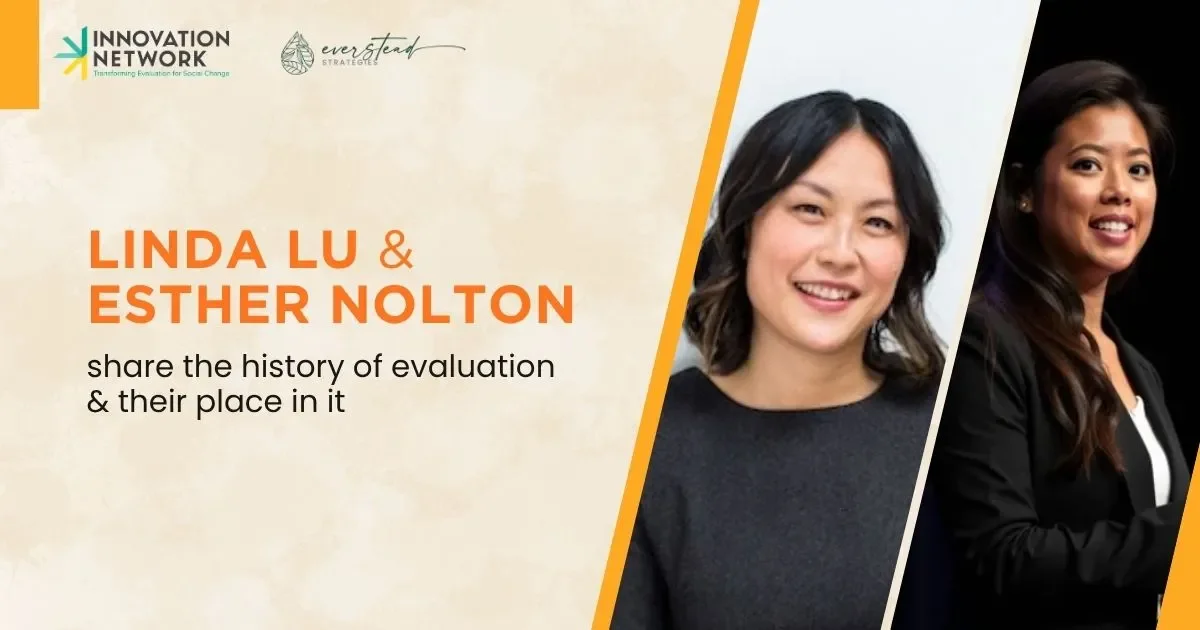
We’re Linda Lu from Innovation Network and Esther Nolton from Everstead Strategies. Acknowledging that evaluation is a long-standing human and communal practice, we’ve come together around a mutual curiosity about the history of evaluation and locating our own personal and professional stories in it. We’ve been exploring that curiosity through the lens of our shared cultural and family histories, asking questions about where those histories, traditions, and ways of knowing that have shaped us fit, or don’t fit, within the story evaluation tells about itself.
We want to revisit a decolonized history of evaluation.
We are at an inflection point and an important moment of transition. At a time when the “field of evaluation” is wrestling with questions of equity, participation, legitimacy, expertise, and power, revisiting history feels like an important opportunity to better understand how the field arrived where it is today and to collectively imagine where it might go.
Many of us may already know what we’re uplifting. Many of us may be even better versed. However, many of us may still think about, and possibly conflate, the history of evaluation with the emergence of evaluation as a Western professional field during the twentieth century, whose history often parallels the development of educational metrics and measurement, the evaluation of federal programs, and the academic institutions and scholars who helped professionalize evaluation.
Reminding our friends, colleagues, and folks in this space that the history many of us have been telling, or know, is really the history of the profession, and not the history of evaluation itself?
Before evaluation became a formal field of practice, people and communities across cultures were coming together to share observations, determine what mattered, make judgments and assessments, transmit knowledge, establish mutual responsibility, and decide what moving forward looked like.
If we conflate the history of the profession with the history of evaluation itself, we risk overlooking the many traditions, knowledge systems, and communities that have shaped how people generate shared understanding, make meaning, assess change, and make collective decisions. We also risk narrowing our understanding of who belongs in evaluation, what counts as knowledge, whose knowledge matters, and what purposes evaluation can serve.
So what becomes possible when we expand our understanding of evaluation’s origins, influences, and future?
Locating the “we” in this exploration
My (Linda Lu) way into evaluation was relatively informal, similar to many others’ stories of finding their way into this work.
I started out with an interest and dedication to gender equity in education on a global level, and had been working in community with an all girls home and school in Tibet. I loved and greatly appreciated my master’s program, which took a humanities approach to culture, education, and policy, unpacking a philosophical, historical, comparative, and anthropological discourse to education. It also allowed me to create my own women’s and gender studies concentration.
My foundational research training was grounded in postcolonial, critical race, and third wave feminist methods. My master’s thesis critiqued ideas of “quality,” the assumptions we make about learning, and the role of evaluation in global gender equity in education. I was wrestling with how dominant Western ideas of enlightenment, reason, progress, and intellectual globalization could hide behind seemingly neutral standards and notions of what “progress” looks like, and how those ideas were fundamentally harmful and antithetical to local and community values.
I knew some of this intellectually, but I also knew it through lived experience. I grew up as a first-generation Taiwanese immigrant, part of a wave of Taiwanese migration to the United States in the early 1980s shaped by political uncertainty, migration, complicated relationships to colonialism, authoritarianism, ethnicity, identity, language, politics, and spiritual traditions. I understood my own disconnection from systems in the United States that presumably existed to serve me, but systematically created conditions that made life harder as an immigrant and as a child growing up poor with a single mom, and experiencing a myriad of harms. I am also Daoist and Buddhist, grounded in my own cosmological relationship to the world, to nature, to community, and to self, and in understandings of balance, harmony, and interconnectedness that were rarely recognized or valued by dominant systems, except perhaps through repackaged versions of mindfulness.
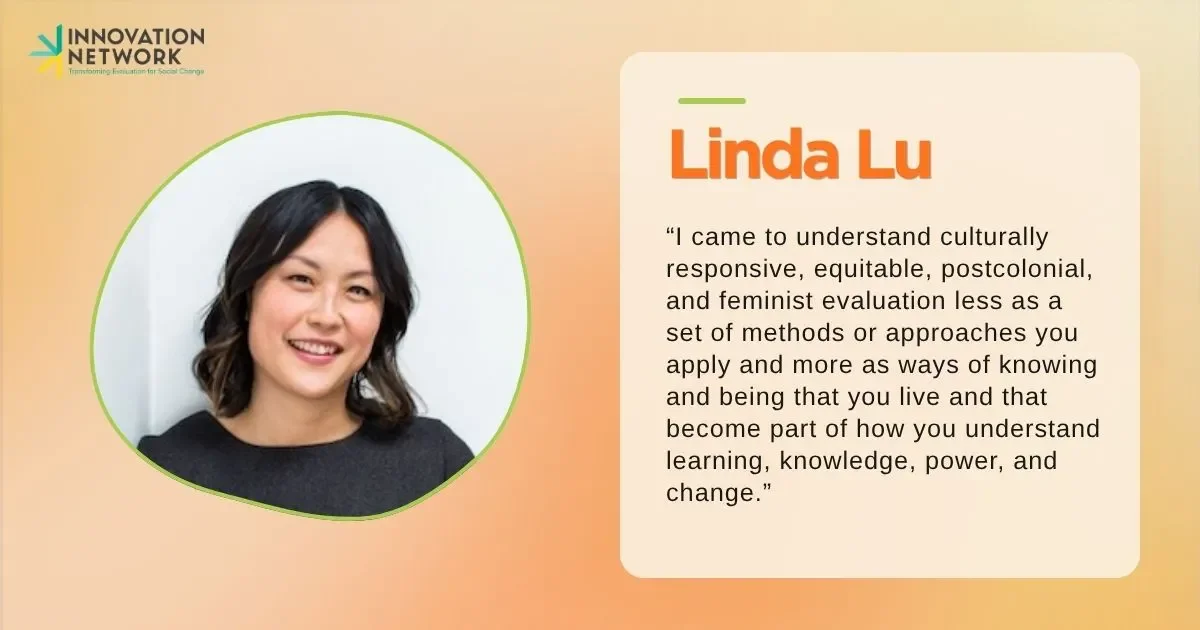
As I grew professionally, I worked internally setting up learning, research, and evaluation systems for statewide coalitions, with organizations who helped build the field of evaluation, and through Evaluation Studio, the postcolonial and feminist evaluation firm I founded. Over time, I came to understand culturally responsive, equitable, postcolonial, and feminist evaluation less as a set of methods or approaches you apply and more as ways of knowing and being that you live and that become part of how you understand learning, knowledge, power, and change.
The Connections
Inspired by our friends at the Center for Evaluation Innovation (CEI), who begin every January with two weeks of independent study, Innovation Network does an independent study the first week of January, sometimes called Inspiration Week. The purpose of this week is to seek inspiration and insight without many rules or guidelines about how we all use that time.
This past January, I wanted to bring my lived experience and postcolonial feminist lens to a question I had been curious about for a while: What exactly is the history of evaluation?
I hadn’t intended for it to be a deep dive. I was simply curious about the history of a space I had long been adjacent to. But part of my postcolonial lens is the importance of understanding and unpacking history and, of course, asking whose history?
In my initial, cursory digging into the resources, leaders, and people who had influenced the field, what was most readily available presented a fairly clear picture: a positivist, Western-centric, extractive history of evaluation. In many ways, what I was finding was the history of the “professionalization of evaluation through a Western academic lens.”
I found myself asking: Where could I locate myself within this lineage? What was the feminist and postcolonial history? Where were the Indigenous, decolonized, feminist, and non-Western histories and, even more fundamentally, different understandings of what evaluation is?
The deeper I went, the more I began to see how dominant, hierarchical, patriarchal, and white supremacist systems of organization were reflected in the history that was easiest to find. It required a much deeper dive before other resources, histories, and lineages began to emerge.
It was at this point that I was fortunate enough to connect with Esther Nolton, who had been unpacking some of these questions through a slightly different lens, particularly evaluation’s relationship to government and the federal system, and who was interested in expanding, extending, and digging into these questions together.
Esther’s way into evaluation
My (Esther Nolton) path into evaluation was unexpected yet organic. Like many other evaluators, including Linda, I stumbled into the field and fell in love with it.
My journey began with a decade as a sports medicine clinician and clinical researcher. I wrote about my transition from evidence-based medicine to evidence-based policymaking in this AEA365 blog post, but suffice it to reiterate here that I realized much later on that I’d been doing evaluation all along without the awareness, jargon, and identity. I quickly translated assessing readiness, effectiveness, and performance at an individual-level to programs, policies, and organizations at a systems-level.
During my doctoral program, I had the opportunity to work at the National Science Foundation when the Evidence Act was enacted. Almost overnight, Chief Evaluation Officers were raised up in all the major agencies and the demand for evaluation surged. While I celebrated that apparent victory, a mentor reminded me it had been a hard-fought journey to get there and there was more work to be done to advance the field and practice.
This truth pushed me to learn more about that history through a historical ethnography of the institutionalization of evaluation in the U.S. federal government. Drawing on institutional theory and professional studies, I examined why (de)institutionalizing evaluation varied so much across a complex system like the federal government, and what organizational and societal factors shape perceptions of the role and value of evaluation. That work feels relevant again now, as we watch large-scale deinstitutionalization unfold and I sit at the forefront of conversations about the mechanisms, policies, and players that could help rebuild a stronger, more resilient infrastructure.
So yes, I’ve studied the history of evaluation (in a particular context), but what stirred in me when Linda reached out about this project was rooted in something more personal. As a Taiwanese American daughter of parents who have advocated for Taiwan’s independence for over five decades, I have been a part of my parents’ fight to preserve Taiwanese culture and language through their children, community programs, and political activism. In fact, I distinctly recall protesting outside the Chinese embassy in DC as a young child and educating adults about Taiwan’s complicated history.
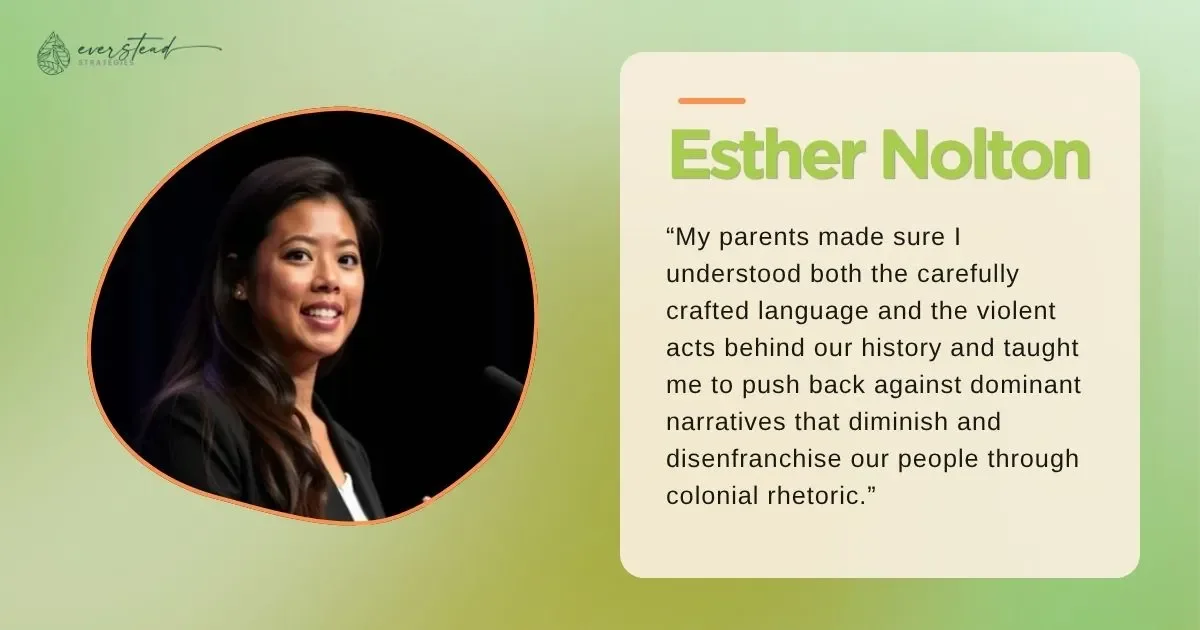
As a historian himself, my dad constantly spoke about our family lineage and how events around the world influence culture, language, and beliefs systems. The dangers of false histories and erasure were things I learned about from a young age. Although my parents never used this terminology explicitly, they spoke candidly about how colonialism, martial law, and genocide shaped our identity as Taiwanese people. They made sure I understood both the carefully crafted language and the violent acts embedded in our history and taught me to push back against dominant narratives that diminish and disenfranchise our people through colonial rhetoric.
As I continue to lead the field as a future President of the American Evaluation Association, I am emboldened to understand and fiercely protect the truth of our history as a long-standing field of practice. Past and present, dominant narratives have retold or untold who we are, what we do, and our value to society, contributing to the erasure and decimation of our field. I hope this work helps reclaim our history and change the course of our future.
Where we hope to go
We want to pay homage to and point folks toward those who have already traced evaluation’s lineages, challenged its dominant narratives as a practice, and pushed us to understand its history through more decolonized, relational, and epistemological lenses[1]. At this critical moment, we want to learn from those histories and build on them as we imagine something better together.
Over the next year, we hope to collaboratively deconstruct, decolonize, and collectively reclaim the history of evaluation.
Our hope throughout this project is to ask and answer some fundamental questions related to the history of evaluation and imagine exploring these questions in bite-sized pieces based on what we learn. In some ways, this is a kind of meta-research: learning in public, uplifting and connecting existing work, pointing people toward resources, and inviting others into the questions with us.
Eventually, we plan to share what emerges more broadly, perhaps through something more expansive and creative. We want this to be a living body of work, evolving in the same ways people have always passed along stories, histories, and knowledge: relationally, collectively, and over time.
We offer sincere thanks to our colleagues, Alissa Marchant and Rodney Hopson, for their review and thoughts as we begin to chart our course.
Please stay tuned as we learn more, with and from others. In the meantime, feel free to share:
● How did you find yourself in the field of evaluation?
● How do you locate yourself in the history of the field?
● What emotions, thoughts, or questions does this work bring up for you?
* We are drawing from a broad and growing body of scholarship, oral histories, practitioners, and community knowledge as we explore this history. Some of our initial starting points include AEA’s Oral History Project and the work of Joan LaFrance, Rodney Hopson, and Stafford Hood, alongside thinkers who have shaped how we understand knowledge, power, colonialism, identity, and research more broadly, including Linda Tuhiwai Smith, Gloria Anzaldúa, Gayatri Chakravorty Spivak, Chandra Talpade Mohanty, and Patricia Hill Collins. We name these as starting points, not a canon or exhaustive list. As we dig deeper, we are also developing our own criteria for whose stories, knowledge, and traditions we include — guided by a commitment to honor those who have shaped and challenged evaluation as a profession without allowing the profession itself to define the boundaries of its history.